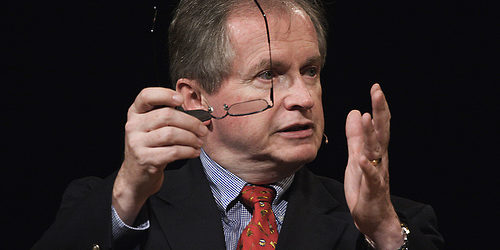
D. A. Carson’s Evaluation of “Theological Interpretation of Scripture”
By Brent Parker –

During the past few years there has been growing interest among evangelical scholars and seminarians in a hermeneutical movement known as Theological Interpretation of Scripture (TIS). The publications of books and articles by TIS advocates or practitioners such as Joel Green, Stephen Fowl, Christopher Seitz, Daniel Treier, Richard Hays, Peter Leithart along with the formation of the semiannual Journal of Theological Interpretation (2007) and such commentary series like the Brazos Theological Commentary have garnered much attention (and gained some traction) in evangelical academic communities. Unfortunately, TIS defies definition since it is not a monolithic movement; nevertheless, the movement generally is a negative response to modern critical and ideological approaches to biblical interpretation and instead seeks to read and interpret the Bible, in light of post-Enlightenment developments (e.g. suspicion of grammatical-historical methods), with multiple lens which generally involves strongly emphasizing traditional pre-critical interpretations, reading within the Rule of Faith (early church creeds) and within one’s ecclesial location (reading in the community), engaging the entire narrative of Scripture (canonical approach), and placing the accent on the role of the reader in interpretation, including the need for the formation and virtue of the reader.
Recently, D. A. Carson has offered a very helpful, timely, and important evaluation of TIS: “Theological Interpretation of Scripture: Yes, But . . .” in Theological Commentary: Evangelical Perspectives
(1) TIS is an attempt to transcend the barren exegeses generated by historical-critical methods, and especially those readings of Scripture that are “historical” in the sense that they are frankly anti-supernatural interpretations determined by post-Enlightenment assumptions about the nature of history.
(2) More broadly, TIS aims to bring biblical studies and theology closer together.
(3) TIS accords greater credibility to pre-critical exegesis – patristic, medieval, reformational – than to contemporary exegesis and especially to patristic readings.
(4) TIS aims to be God-centered as opposed to human-centered (including human-hermeneutical-rules-centered).
(5) TIS commonly insists we ought to read Scripture through Trinitarian lenses.
(6) TIS tends to see Scripture less as a set of propositions disclosing God than as a story of God and his saving plan of redemption.
Space does not permit a full summary of each of these propositions but I would like to track a few of the salient challenges to TIS that Carson presents.
First, under proposition 3, Carson notes that defenders of TIS write as if the ecumenical councils share the authority of Scripture, or they argue that the councils should not be questioned since they are much closer to Christ and the apostles than we are, and further, they present that the councils constitute all that is necessary to establish a confessional bond of true Christians today. This last area is a stance which marginalizes the Reformation standards according to Carson (197). Moreover, no informed evangelical Christian will agree that the books of the Bible and creeds share the same authority. While there is much to be grateful for in the councils, the creeds must be tested by Scripture and not the reverse. Carson then adds this helpful insight in regard to the TIS propensity to exalt patristic writings: “The fact that the fathers were closer to the events described in the New Testament and to the time of writing of those documents is almost irrelevant. Most of them were, after all, hundreds of years removed. In the patristic period as in all others, there were better interpreters (John Chrysostom, Augustine) and worse interpreters (Origen). Some years ago I set myself the task of reading Origen’s massive commentary on Romans. . . . With the best will in the world, I find it difficult to imagine that many would be so bold as to claim that Origen understands what biblical texts are actually saying as well as Chrysostom does, or as well as, say, John Calvin understood Romans in the Reformation period, or Joseph Fitzmyer does today” (197-98). Ultimately, we ought to listen attentively to past saints in the pre-critical eras, but Carson finds that the TIS approach and emphasis on patristic writings to be troubling.
Under the same proposition, the often confusing topic of allegory appears. This is important given the constant appeal to “figural reading” whereby typology and allegory are brought together in the writings TIS advocates. What exactly is meant by allegorical readings among TIS supporters? Sophisticated treatments of allegory, notes Carson, argue that the distinctive element of allegory is that it requires an interpretative grid not in the text itself. Thus, an extratextual grid is superimposed on the text. Questioning the warrant for justifying this kind of allegorical reading, Carson further avers that the appeal to the “analogy of faith” or “rule of faith” as a legitimate extratextual grid will also not do, for even this must be shown to be grounded in the text of Scripture (198). Carson finds that in terms of learning from pre-critical eras, “one begins to grow in respect for the Reformers who thought their way clear of fuzzy notions of allegory to a greater dependence on ‘literal’ interpretation (without losing a sophisticated grasp of metaphorical language), and less of TIS support for unspecified allegory” (199).
Carson makes many important points on how the subject of history is treated among TIS supporters throughout his article. But to conclude this post, I’ll pick up on his critical observations under his sixth proposition. First, tiring of the endless swipes at the presence of propositions in the Bible, Carson flatly highlights that the Bible is more than propositions (riddles, narrative, commands, warnings, etc.); nevertheless there is still no lack of propositions in the Bible. In fact they even lurk behind other forms, such as laments or proverbs (206). Second, the emphasis on the unity of the storyline of the Bible is a good one, however, recognizing and concluding that there is a central storyline does not necessarily mean that one has accurately read the storyline well. Ultimately how one puts the storyline together will have a major impact on the theology that is constructed upon such an understanding.
The insights that Carson offers are helpful and those interacting with TIS writings and works are heartily encouraged to read Carson’s chapter. Moreover, see also Andy Naselli’s article, which has presented Carson’s theological method. In summary, Carson concludes that the most valuable components in TIS are actually not new and have been present in the writings of evangelicals. But “what is new in TIS varies from ambiguous to mistaken, depending in part on the theological location of the interpreter” (207).
Brent Parker is a Ph.D. candidate in systematic theology at the Southern Baptist Theological Seminary.
Advertisment